Pan-African Parliament President Warns of New Scramble for Africa in the Digital Age

The President of the Pan-African Parliament, H.E. Chief Fortune Charumbira, has issued a powerful call for Africa to reclaim control over its intellectual, digital, and political future, warning that the continent risks a new era of domination if it fails to assert sovereignty over its data, knowledge systems, and academic institutions.
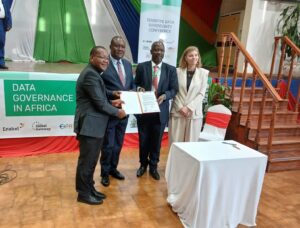
Speaking at the Sensitive Data Sovereignty Conference held on 27 January 2026 at Tangaza University in Nairobi [VIDEO], Kenya, Chief Charumbira situated Africa’s struggle for development within the broader historical context of colonialism, economic exploitation, and external control. He argued that in the digital age, domination is no longer enforced through territorial occupation alone, but increasingly through control of information, technology, and artificial intelligence systems.
“At the heart of Africa’s future lies the question of who owns and controls our data,” he stated, warning that African societies are rapidly becoming sources of raw digital material for foreign corporations and governments, while receiving little economic or intellectual benefit in return.
Chief Charumbira stressed that digital data has become the foundation of modern power, shaping political discourse, economic systems, and social behaviour. Without ownership of this data, he cautioned, African nations would remain vulnerable to manipulation, surveillance, and economic marginalisation.
Drawing on African wisdom, he reminded delegates that “until the lion learns how to write, the story will always glorify the hunter,” emphasising that control over data and knowledge is inseparable from control over narrative and identity. He argued that African academic institutions must become centres of independent thought, grounded in African values, history, and epistemology, rather than passive consumers of externally generated knowledge.
The Pan-African Parliament President further warned of the emergence of “digital colonialism,” where sensitive personal, health, and genetic data of African citizens is stored and processed outside the continent. Such practices, he said, undermine human dignity and expose vulnerable communities to exploitation.
He highlighted particular concerns over health and biometric data, noting that uncontrolled cross-border transfers of sensitive information could lead to commercial abuse, discrimination, and violations of fundamental rights. In this context, he insisted that data sovereignty is not merely a technical issue, but a moral and political obligation.
Chief Charumbira reaffirmed the African Union’s commitment to protecting digital rights, referencing the Malabo Convention on Cybersecurity and Personal Data Protection as a foundational framework for African-led regulation. He announced that the Pan-African Parliament is developing model laws on cybersecurity and artificial intelligence to harmonise legal standards across member states.
“These instruments must reflect African realities and priorities,” he said, adding that imported regulatory models often fail to address the continent’s unique social and developmental challenges.
Central to his address was the role of universities and research institutions in shaping Africa’s digital future. He described African universities as “guardians of independent thought” and called on them to resist intellectual dependency by investing in local research infrastructure, data systems, and innovation ecosystems.
Through networks such as the Africa University Network on FAIR Open Science, he said, African institutions are beginning to demonstrate that it is possible to combine technological innovation with sovereignty and ethical governance.
Chief Charumbira also praised African engineers and researchers working through initiatives such as VODAN for developing data architectures that keep ownership and control within the continent. He described these efforts as practical steps towards breaking “the chains of digital imperialism.”
However, he cautioned that technical innovation alone is insufficient without strong political will. Governments, legislatures, civil society, and academia, he said, must work together to ensure that Africa’s digital transformation serves public interests rather than foreign profit motives.
In outlining his vision for the future, the Pan-African Parliament President called for the establishment of an African Data Space and an African Health Data Space, where sensitive information can be generated, stored, and analysed within African jurisdictions. Such platforms, he argued, would enable research collaboration while safeguarding sovereignty.
“We need African engineering for Africa,” he declared, stressing that development must be driven by African priorities and controlled by African institutions.
Chief Charumbira concluded by urging stakeholders to embrace a unified continental approach to data governance, warning that fragmented national policies would leave Africa exposed to global technological monopolies.
“Our collective future depends on our ability to think, innovate, and govern in our own interests,” he said. “Data must empower our people, strengthen our economies, and protect our dignity.”
Reaffirming the Pan-African Parliament’s guiding principle of “One Africa, One Voice,” he challenged academic institutions to become active participants in Africa’s liberation from digital dependency.
His address marked a significant moment in the evolving discourse on African sovereignty, signalling that the struggle for self-determination has entered a new phase, one fought not only on political and economic fronts, but in the realms of knowledge, technology, and consciousness.