PAP President Warns Against Blind AI Adoption and Externally Driven Green Agendas
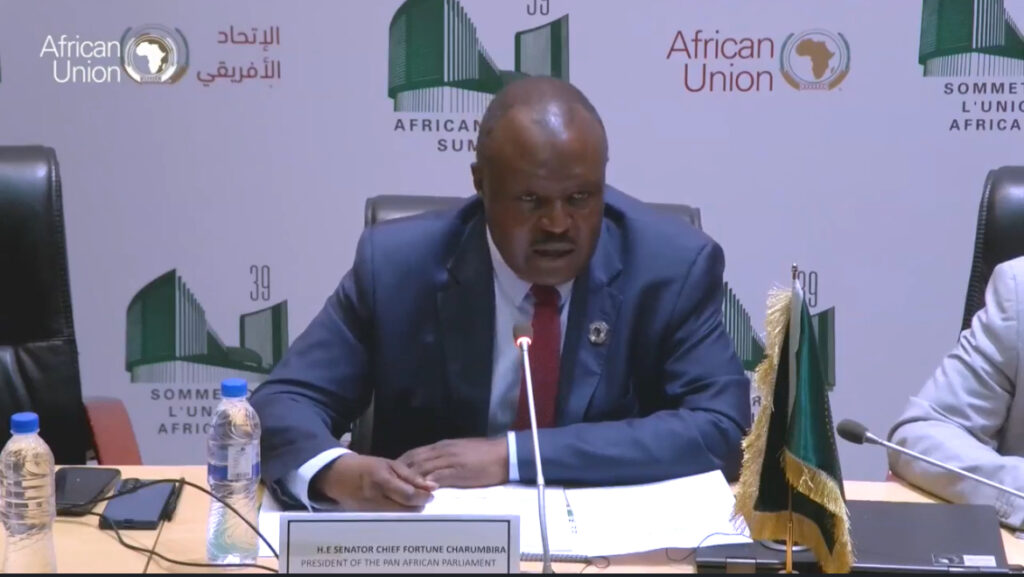
Pan-African Parliament President Hon. Chief Charumbira press briefing at 48th Ordinary Session of the African Union Executive Council Addis Ababa Ethiopia 2026
Africa must not mortgage its industrial future at the altar of fashionable global agendas. That was the unmistakable message from H.E. Chief Fortune Zephaniah Charumbira, President of the Pan-African Parliament (PAP), during a media briefing held on the sidelines of the ongoing African Union meetings in Addis Ababa.
Responding to a pointed question from Hillary Panashe of LN24 SA International on artificial intelligence, industrialization, and the so-called “just energy transition,” saying Africa cannot afford policy romanticism when jobs, sovereignty, and structural transformation are at stake.
The PAP President acknowledged the global celebration of artificial intelligence but cautioned against uncritical adoption.
“It is true that as we celebrate artificial intelligence everywhere in the world, we have not quite understood some of the repercussions.”
For a continent where more than 60 percent of the population is youth, and where unemployment remains one of the gravest socio-economic challenges, AI presents a paradox.
“At a time when we are saying the youth have no jobs, AI is cutting the jobs. In very significant proportions. It’s a contradiction.”
While some argue that AI will create new digital opportunities, Chief Charumbira emphasized that even experts and developers of AI have raised concerns about its disruptive capacity.
“Some of the developers of AI are also a bit pessimistic… It is at the moment eliminating the number of jobs in most organizations.”
Africa is warned to evaluate AI not as a trend to follow, but as a tool to strategically deploy, ensuring it complements rather than cannibalizes already fragile industrial and employment bases.
The question posed by LN24 struck at the heart of a growing policy tension: Can Africa industrialize while simultaneously embracing externally prescribed green transition timelines?
The African Union has consistently prioritized: resource beneficiation, manufacturing expansion, value addition to critical minerals, and energy-intensive industrialization. However, energy is the foundation in this equation.
On the “just energy transition,” he urged caution.
“This game of climate change and what should be done, we in Africa, of course, are paying the highest cost.”
He referenced deliberations at global climate forums, including COP meetings, where developing nations have repeatedly highlighted the inequities of transition financing.
India, he noted, was candid about its coal dependence, and skeptical of promises made by developed nations to fund transitions.
“Monies have been promised. They don’t come. The money doesn’t come.”
For Africa, a transition model that relies on unreliable foreign investment is likely to undermine energy security or slow industrial take-off, as well as entrench dependency rather than ending it. Without naming names directly, The PAP President alluded to developments in Europe, where rapid green energy transitions have coincided with signs of industrial strain in certain economies.
For a continent still struggling to industrialize, replicating policies that appear to contribute to de-industrialization elsewhere would be strategically reckless.
“There’s nothing like justice.”
The message was not climate denialism. It was a demand for realism. Africa contributes the least to global emissions yet bears disproportionate climate consequences. At the same time, it remains energy-poor and industrially underdeveloped. To impose uniform transition expectations without credible financing and technology transfer would, in effect, penalize Africa twice.