
African Union’s Agrifood Transformation Department to Engage Côte d’Ivoire
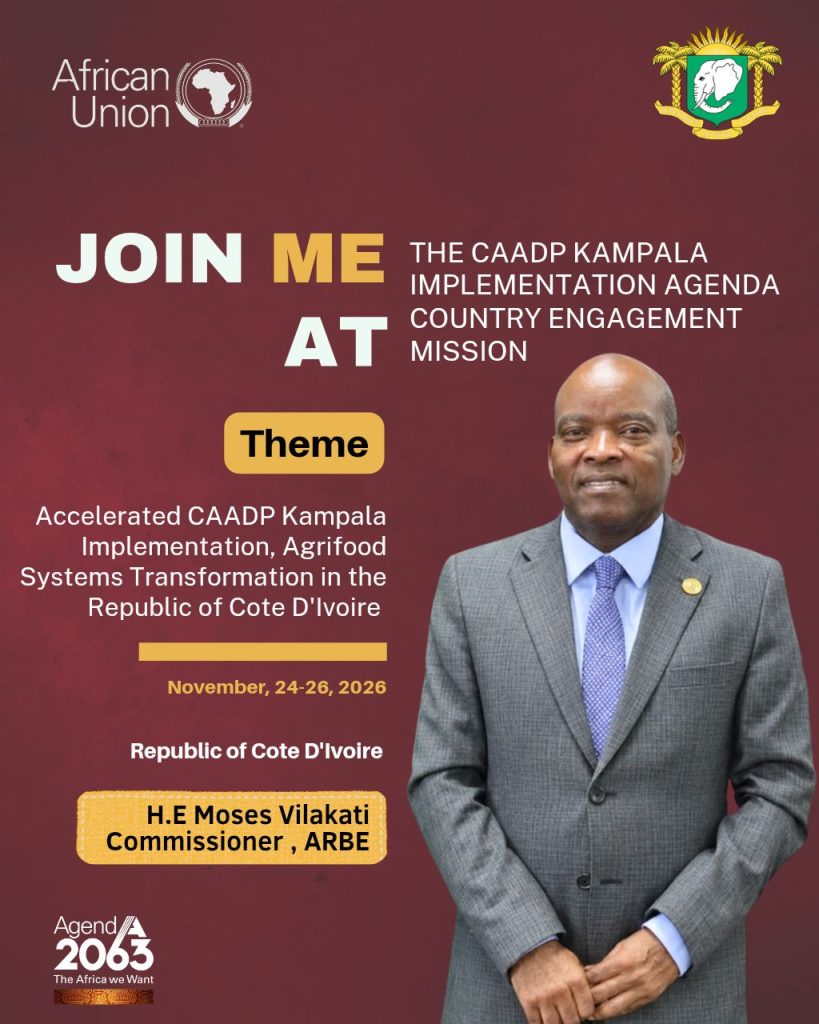
The African Union Commission (AUC), through its Department of Agriculture, Rural Development, Blue Economy and Sustainable Environment (ARBE), has announced a high-level country engagement mission to Côte d’Ivoire from 24 to 26 November 2026, led by H.E. Moses Vilakati, Commissioner for Agriculture, Rural Development, Blue Economy and Sustainable Environment.
The Côte d’Ivoire engagement comes at a critical stage in the country’s agricultural transformation, as it confronts mounting pressures from climate change, declining agricultural productivity, food insecurity and the vulnerability of smallholder livelihoods. Despite its position as a leading agricultural producer and global cocoa exporter, the country continues to grapple with low crop yields, limited irrigation infrastructure, declining soil fertility and inadequate access to quality agricultural inputs.
These challenges are compounded by increasingly unpredictable rainfall, ageing cocoa plantations, plant diseases and fluctuations in commodity prices, which threaten farmers’ incomes and the resilience of rural communities. According to the FAO, approximately 1.3 million people faced acute food insecurity during the 2026 lean season, while the country’s northern regions remain particularly exposed to insecurity and disruptions to agricultural livelihoods.
Against this backdrop, the Commission’s engagement provides an important opportunity to strengthen national ownership and accelerate the implementation of the CAADP Kampala Declaration by aligning continental agricultural commitments with Côte d’Ivoire’s national development priorities, mobilising investment, strengthening agricultural value chains and advancing climate-resilient, inclusive and productive food systems.
The Côte d’Ivoire mission builds on a series of high-level country engagements and continental implementation initiatives undertaken by the African Union Commission to accelerate the domestication of the Kampala CAADP agenda across Member States. These have included the AU High-Level Mission to Malawi in June 2026, which marked the first national engagement under Commissioner Vilakati’s 100-Day Rolling Plan; a High-Level Policy Dialogue in Uganda in September focused on aligning continental commitments with national priorities and investment frameworks; and a subsequent country engagement mission to Tanzania in November to identify strategic investments for accelerating agrifood systems transformation. The implementation drive has also been reinforced through Zimbabwe’s hosting of the 22nd CAADP Partnership Platform in September and Eswatini’s hosting of the inaugural Africa Seed Summit in October, alongside national-level efforts to domesticate the Kampala framework through agricultural investment planning and technical cooperation.
Background
Adopted in 2025, the Kampala CAADP Declaration establishes Africa’s agricultural transformation agenda for the 2026–2035 period. Building on the foundations of the Maputo and Malabo Declarations, the framework seeks to accelerate the transformation of African agrifood systems, strengthen food and nutrition security, increase agricultural productivity, expand intra-African trade and build resilience against climate and other systemic shocks.
Its implementation, however, depends on the ability of individual Member States to translate shared continental objectives into country-specific priorities and institutional arrangements.
Role of the African Union Commission
The Department of Agriculture, Rural Development, Blue Economy and Sustainable Environment is responsible for advancing the African Union’s policy priorities and continental programmes across agriculture, rural development, the blue economy and environmental sustainability.
Through its mandate, the department supports Member States in advancing agricultural transformation, strengthening food systems, improving rural livelihoods, promoting sustainable natural resource management and addressing environmental and climate-related challenges.
Under the leadership of Commissioner Moses Vilakati, the department’s work recognises that Africa’s agrifood transformation requires an integrated approach that extends beyond agricultural production to encompass value addition, agro-industrialisation, access to markets, trade, infrastructure, research, technology, financing and climate resilience.
The three-day engagement in Côte d’Ivoire forms part of this broader effort to build the partnerships, implementation structures and investment foundations required to advance the Kampala Declaration and accelerate the transition towards more productive, resilient, inclusive and sustainable agrifood systems across Africa.


