Eswatini Minister Calls for Whole-of-Government Approach to Agricultural Transformation

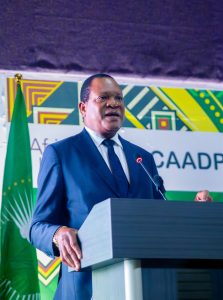
AU-CAADP-Minister of Agriculture of the Kingdom of Eswatini, Honourable Mandla Tshawuka
The Minister of Agriculture of the Kingdom of Eswatini, Honourable Mandla Tshawuka, has called for a decisive shift from policy commitments and discussions towards concrete implementation that delivers measurable improvements to rural communities.
Speaking on Tuesday during the High-Level Dialogue on CAADP Kampala Implementation Readiness, Minister Tshawuka emphasised that the Kampala Declaration must now be translated into practical action on the ground.
“Everything depends now on implementation,” he said, stressing that African countries were not short of ideas or plans, but required stronger action to ensure that agricultural commitments produce tangible results for communities.
Agriculture as an Investment in Economic Development
Minister Tshawuka said Eswatini had adopted a whole-of-government and whole-of-society approach to agricultural transformation, recognising that agriculture should not be treated merely as a cost or expenditure.
According to the Minister, investment in agriculture generates wider economic benefits by stimulating secondary industries, value chains, employment and trade. He noted that Eswatini was working to improve its budget allocation in line with its Kampala commitments, although fiscal constraints had resulted in agricultural spending remaining at approximately 6 to 7 per cent.
He further highlighted the importance of creating conditions that enable farmers to thrive, particularly through improved water availability. Eswatini is constructing the Gondwana-Buma-Otto project, which is intended to combine dam development, irrigation, agro-processing and an eco-city within an integrated, multisectoral development zone.
The project reflects the country’s intention to move beyond primary agricultural production and develop opportunities across processing, logistics, technology and agro-technology. Minister Tshawuka said this broader approach could make agriculture more attractive to young people and create employment opportunities beyond farming itself.
Promoting Inclusion Across the Agricultural Sector
The Minister also outlined Eswatini’s efforts to ensure that agricultural policies and programmes reach vulnerable and marginalised groups, including women, youth and persons living with disabilities.
He cited initiatives supported by the World Bank and the International Fund for Agricultural Development, which seek to create employment opportunities and expand participation in the agricultural sector.
Minister Tshawuka argued that agriculture should be presented as a viable career and an economic pathway, rather than being associated only with primary production. He identified agro-processing, logistics and technology as areas through which young people could participate in the agricultural economy.
Addressing Agricultural Financing Constraints
Financing emerged as one of the central challenges identified by the Minister. He explained that commercial banks often perceive agriculture as high-risk, resulting in agricultural initiatives competing unsuccessfully with other sectors for available capital.
In response, Eswatini had established the Swaziland Agricultural Development Fund, according to the transcript, to support agricultural initiatives and address risks that commercial lenders may be unwilling to assume. The fund also incorporates crop insurance measures intended to protect farmers and strengthen the resilience of agricultural systems.
Minister Tshawuka stressed that farmers require more than access to finance. They also need reliable inputs, markets, processing facilities, technology and infrastructure to ensure that production translates into sustainable livelihoods.
He noted that agro-processing could strengthen market access, create predictable purchasing arrangements, extend the shelf life of agricultural products and provide farmers with greater certainty that their produce would generate income.
Climate Change Identified as a Major Implementation Bottleneck
Responding to a follow-up question on the most significant bottleneck beyond financing, Minister Tshawuka identified climate change as a major threat to agricultural delivery in Eswatini.
He described how the country had experienced highly concentrated rainfall followed by a prolonged period of drought, damaging soils, reducing nutrients and severely affecting maize production.
The Minister warned that traditional dependence on rainfall was no longer sufficient. He called for expanded irrigation, improved water management and climate-resilient agricultural technologies capable of protecting production during periods of excessive rainfall and drought.
He said Eswatini was implementing programmes to provide productive farming equipment, feedlots and greenhouses for high-value crops, while also using technology to strengthen climate resilience. However, he cautioned that such interventions needed to be implemented at scale to protect a greater proportion of the country’s agricultural production.
From Conferences to Community-Level Impact
Concluding his presentation, Minister Tshawuka emphasised that rural communities would judge agricultural commitments by the practical improvements they experienced, rather than by the number of meetings convened.
He called for farmers to receive better access to inputs, financing, markets, processing facilities and technologies, noting that these were the measures most likely to improve livelihoods and contribute to economic development.
His intervention reinforced the central message of the panel: Africa’s agricultural transformation will depend on moving from declarations and plans to coordinated, adequately financed and climate-resilient implementation that delivers results for communities.